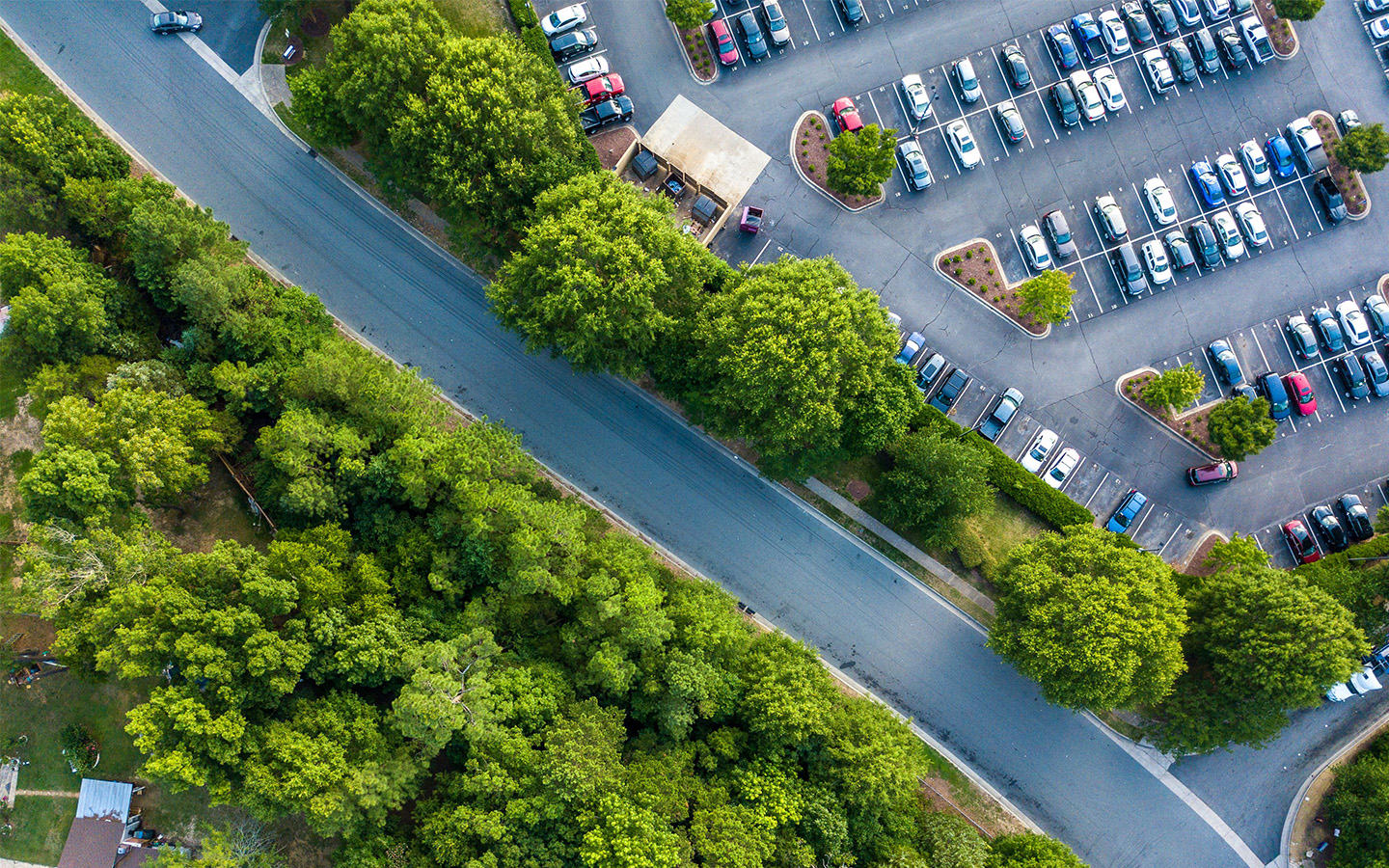
An asphalt parking lot consists of concrete, tar, and a surface temperature that can exceed 60°C in the height of summer. It is no coincidence that, during heat waves, suburban commercial areas and their vast parking lots appear as hotspots on urban thermal maps. Yet these spaces offer considerable, often untapped potential for renaturation.
In France, parking areas cover several hundred thousand hectares. A large portion of these areas is completely impervious, which directly contributes to the exacerbation of urban heat islands (UHIs), stormwater runoff, and the decline of local biodiversity. Greening these spaces is not merely an aesthetic choice: it is a concrete response to climate, regulatory, and economic challenges.
Asphalt surfaces absorb and retain solar heat for much longer than vegetated surfaces. The effect is measurable: under identical conditions, a paved surface can reach a surface temperature 10 to 20°C higher than that of a grassy or wooded area.
This buildup of heat has direct effects:
Greening a parking lot does not necessarily require eliminating parking spaces. There are several approaches depending on the scope of the project:
Also known as grass pavers or interlocking pavers, this type of paving replaces asphalt with a structure that allows vegetation to grow between the interlocking cells. The ground remains permeable, water seeps through naturally, and the surface stays cool through evapotranspiration. It is the solution best suited for maintaining the area’s use as a parking lot.
Planting tall trees along roadways is one of the most cost-effective measures in terms of impact. The shade they provide directly reduces the perceived temperature (UTCI) and protects vehicles. In Lyon, a simulation conducted by Netcarbon on an airport parking lot shows that planting 100 trees combined with 2,500 m² of porous pavement can, over 25 years, lower the surface temperature by -1.76°C, improve the biotope coefficient by +0.2, and store an additional 17 tCO2.
Incorporating landscaped swales or planted strips along access roads and at property boundaries provides thermal and hydraulic benefits while creating ecological corridors.
This hybrid solution combines solar energy generation, shade, and, in some cases, greenery. Since the law of March 10, 2023, outdoor parking lots larger than 1,500 m² are required to be equipped with photovoltaic shade structures, which opens up an opportunity to simultaneously rethink the landscaping.
The Climate and Resilience Act (2021) sets a target of Zero Net Land Take (ZAN) by 2050. In this context, the removal of impervious surfaces from existing parking lots is explicitly promoted as a renaturation measure. Parking areas represent one of the primary sources for removing impervious surfaces identified in intermunicipal Local Urban Planning (PLU) documents.
In addition, the Biotope-to-Area Ratio (CBS) requires, in a growing number of municipalities, a minimum percentage of green space relative to the total area of the lot. Green parking lots directly contribute to meeting this requirement.
One of the main obstacles to taking action is often the lack of data needed to justify an investment and choose between different scenarios. This is exactly where a tool like Netcarbon comes in: using aerial imagery, the platform generates a thermal and environmental assessment of the existing site, then simulates the impact of various greening scenarios over 25 years—in terms of temperature, carbon sequestration, biodiversity, and soil restoration.
This approach allows for objective comparisons: planting 50 trees versus 100 trees, replacing 30% or 60% of asphalt surfaces, and deciding whether or not to include shade structures. The result: quantifiable data that supports investment decisions and documents environmental benefits for reports and stakeholders.
Greening a parking lot means transforming a liability—an artificial surface that absorbs heat—into a valuable environmental asset. In a context where the ZAN, the European Taxonomy, and new requirements for solar canopies are reshaping the rules of the game, parking lot operators no longer have the luxury of waiting. Those who act today have a real competitive advantage: verifiable data, increased climate resilience, and regulatory compliance ahead of the curve.
Do you manage a parking lot and want to measure its thermal and carbon footprint? Get a Netcarbon assessment of your site in less than 72 hours.

.png)