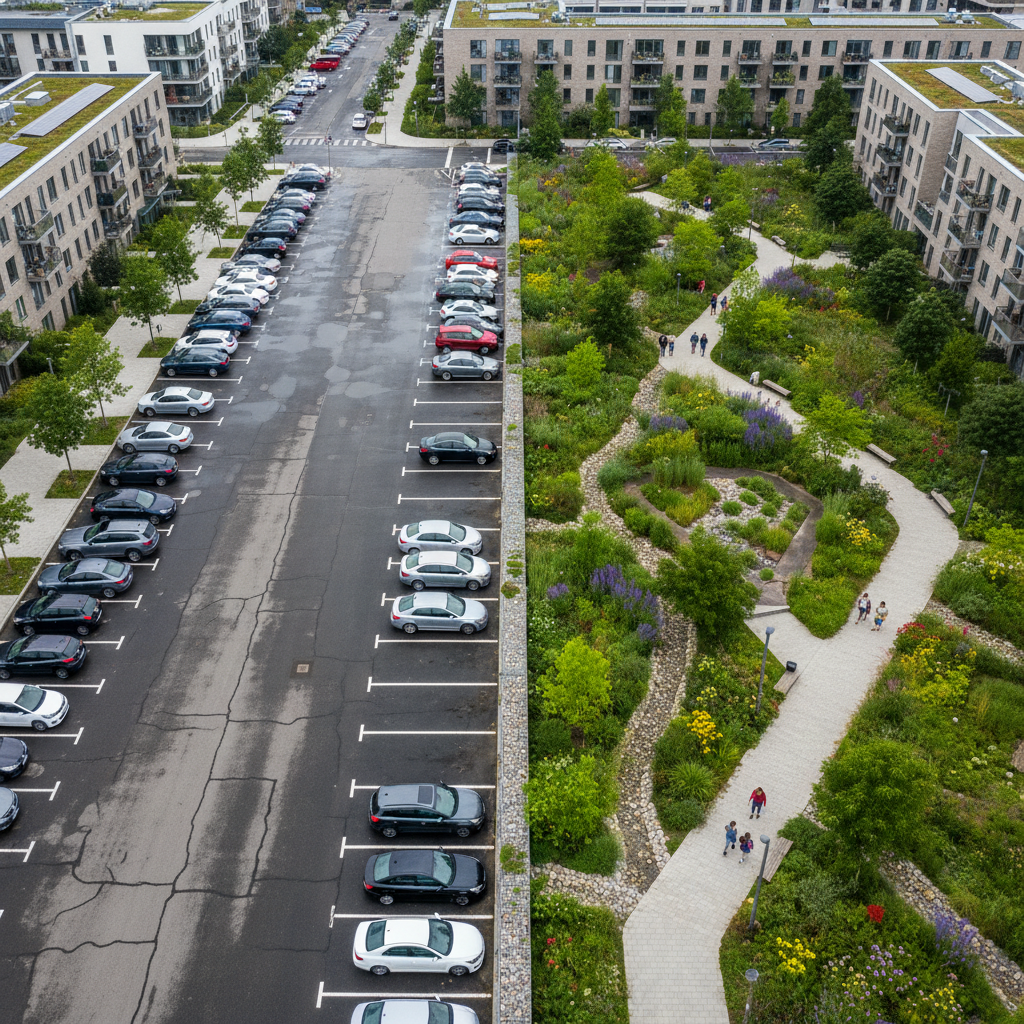
De-impermeabilization refers to the process of removing or replacing an impermeable surface with a permeable or vegetated surface, thereby allowing water to infiltrate the soil once again.
It differs from de-artificialization in the strict sense, which involves restoring land to its natural or semi-natural state. Under the ZAN Act, de-impermeabilization contributes to counting “de-artificialized” areas as long as it results in effective renaturation.
Natural soil absorbs between 50% and 90% of rainwater. Impermeable soil absorbs between 0% and 10%. This excessive runoff is one of the main causes of urban flooding.
An unpaved surface absorbs solar radiation and releases it at night in the form of heat. The difference in surface temperature between an asphalt parking lot and a green space can reach 20°C to 25°C on sunny days.
Sealed soil is dead soil. Removing the seal, followed by restoration, allows the soil’s flora and fauna to gradually recover. Living soil can sequester between 0.5 and 3 tons of CO2 per hectare per year.
The Climate and Resilience Act (2021), as amended by the Act of July 20, 2023, sets two objectives:
Local Urban Planning (PLU) and Territorial Coordination Plans (SCoT) must incorporate ZAN objectives, including an assessment of impervious surfaces, reduction targets, and concrete measures to restore permeability.
The CBS measures the proportion of areas conducive to biodiversity on a plot:
The most radical approach: removing impervious surfaces and replanting. It is the most environmentally effective option, but also the most expensive.
Permeable pavers, stabilized gravel, and porous concrete: these materials allow for traffic or parking while restoring partial permeability to the ground.
Creating swales, rain gardens, or green spaces in place of paved areas is effective and beneficial to the local environment.
High-resolution aerial imagery makes it possible to map these indicators across an entire region in just a few days, without the need for field surveys. Netcarbon analyzes these images to produce maps at the parcel level.
De-impermeabilization applies to: local governments (roads, schoolyards), developers (green roofs in new construction projects), public housing providers (residential courtyards), infrastructure companies (parking lots), and businesses (courtyards and parking lots).
Would you like to know the level of carbon sequestration in your region or on your property? Netcarbon can map it in just a few days, without the need for field surveys. Request a demo.

.png)