Removing waterproofing from public housing: how social housing providers are making their buildings more eco-friendly

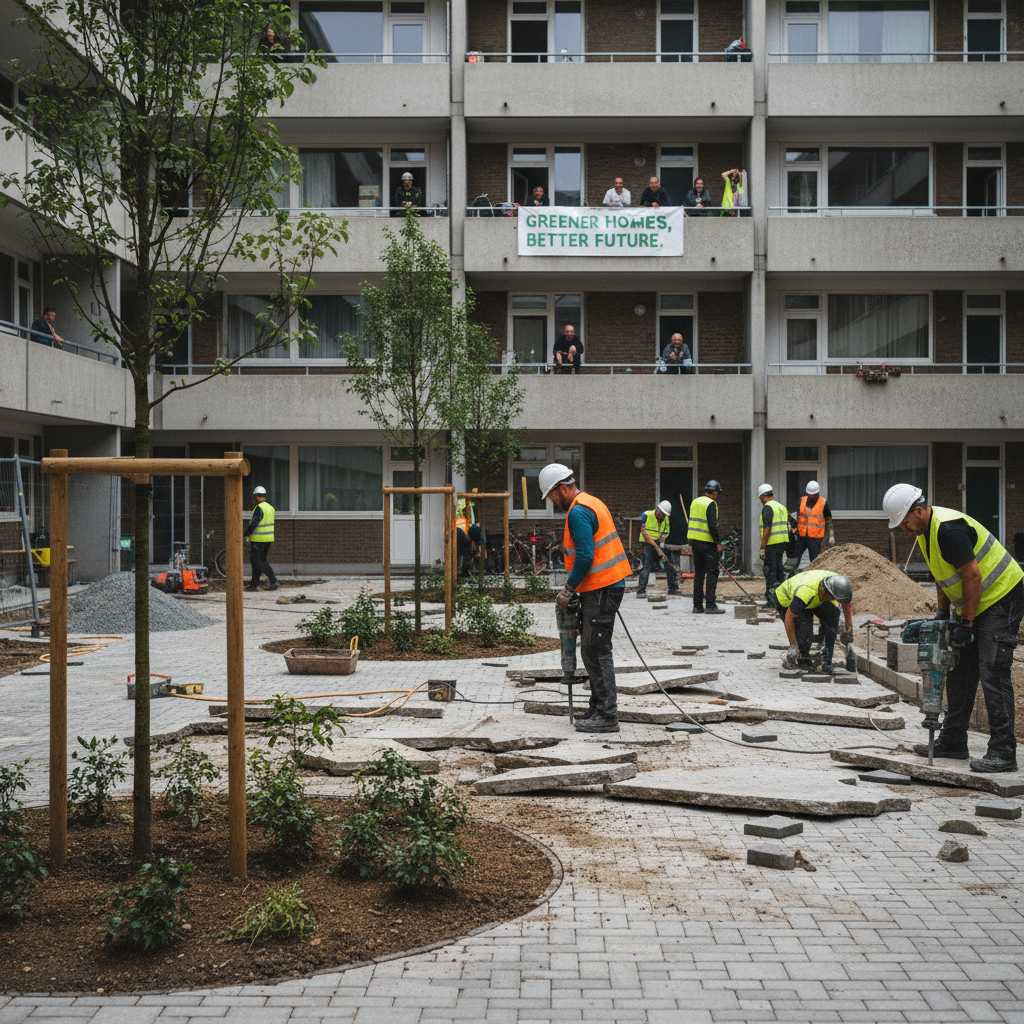
Removal of waterproofing from a public housing complex
March 13, 2026
Contents
Do you have any questions?
Contact us

Removing waterproofing from public housing: how social housing providers are making their buildings more eco-friendly

It is not uncommon to find housing complexes from the 1970s where 70 to 80 percent of the outdoor spaces are paved. This architectural legacy poses significant challenges in terms of thermal comfort, stormwater management, and compliance with ESG reporting requirements.

Making this housing stock more accessible is both a means of improving tenants’ quality of life and a strategic priority in social housing organizations’ sustainable development policies.

A natural heritage with significant potential for restoration

Assessing the current situation: the first essential step

For a landlord managing 200 properties across several counties, accurately answering the question "What is my imperviousness rate?" is a complex task. Analysis of aerial imagery makes it possible to produce a comprehensive and consistent assessment within a few weeks: for each site, the proportion of impervious surfaces, vegetated areas, tree cover, and surface temperature.

The areas with the greatest potential

  • Residential parking lots: often oversized, they occupy large areas that could be partially landscaped
  • Internal service roads: can accommodate lateral landscape swales
  • Schoolyards and play areas: priority candidates for "Oasis Courtyard" projects
  • Building basements: can accommodate basement gardens

De-impermeabilization and climate resilience: the dual benefit

For tenants: thermal comfort and quality of life

In practical terms, an unpaved, green outdoor space means:

  • Surface temperatures 5 to 15°C cooler in summer
  • Better rainwater management
  • A more pleasant living environment that reduces tenant turnover

For landlords: compliance and value enhancement

  • CSRD: Reducing Exposure to Physical Climate Risks
  • European Taxonomy: A Contribution to the Goal of Adapting and Protecting Ecosystems
  • Sustainability reporting: indicators for green space, CBS, temperature

Plan and prioritize fleet-wide maintenance

The prioritization matrix

A multi-site diagnostic tool allows you to cross-reference multiple criteria:

  • Current waterproofing rate
  • Exposure to ICUs
  • Vulnerable population density
  • Potential for greening

This matrix enables the development of a streamlined multi-year investment plan that can be presented to the board of directors.

Run a simulation before committing funds

Simulation allows us to compare intervention scenarios before implementation: How many degrees are gained for every 200 square meters of unsealed and planted area? What is the impact on the CBSh? What is the potential for carbon credits?

The Low-Carbon Label as a Financing Tool

Planting projects on unsealed areas may be eligible for the "Low-Carbon, Tree-Lined City" certification. It’s a virtuous cycle: unsealing generates carbon credits, which fund new plantings, which in turn generate new credits.

Conclusion

Social housing stock is one of the most impermeable areas in our cities—and one of the most transformable. Social housing providers who tackle this challenge systematically—through assessment, prioritization, simulation, and measurement—are doing more than just meeting regulatory requirements. They are tangibly improving their tenants’ living conditions and building a strong case for their investors.


Would you like to assess the potential for removing impervious surfaces from your properties? Request a multi-site assessment.

Satellite image of Salale Tanzania

Are you running a carbon storage project?

Contact us

Our blogs

Combating UCCs: How Local Governments Can Measure and Demonstrate Their Impact

Climate Transition: Why Data Is the Real Driving Force Behind the Next Municipal Terms

Removing waterproofing in real estate projects: a regulatory requirement and a competitive advantage

Urban heat islands: Understanding the phenomenon to take more effective action

Heat Islands on Airport and Highway Rights-of-Way: Measure to Take Action

Removing waterproofing from public housing: how social housing providers are making their buildings more eco-friendly

Urban brownfields: an underutilized tool for land and environmental policy

Heat islands: How developers are addressing thermal considerations in their development projects

Reducing Urban Heat Islands in Construction Projects: Requirements and Methods for Developers

The Low Carbon Label and Real Estate Developers: How to Incorporate Carbon Sequestration into Your Development Projects

Schoolyards, Oases, and ZAN: How Unsealing Schoolyards Contributes to the Net Zero Land Take Goal

Oasis Playground: Turning the Schoolyard into an Urban Oasis

Removing Waterproofing from Historic Buildings: ESG Considerations and Methods for Social Housing Landlords and Real Estate Companies

Removing waterproofing in new construction projects: incorporating the CBS from the design phase to meet RE2020 and ZAN requirements

Green parking lots in urban development projects: how to use them as a regulatory and marketing selling point

Greening Parking Lots: What Local Governments Can Require, Fund, and Measure

Shopping Center Parking Lots: How Real Estate Companies Are Turning Their Asphalt Surfaces Into Green Assets

How the popcorn industry pays its farmers based on the carbon sequestered in the soil

PCAET and Carbon Sequestration: A Guide to Understanding and Acting

Acting for the Planet: The Crucial Role of Carbon Storage

Hedges: climate soldiers

Change the World with Soil: 4 for 1000 Initiative Essentials

Beyond Emissions Reduction : The Co-benefits of Carbon Capture