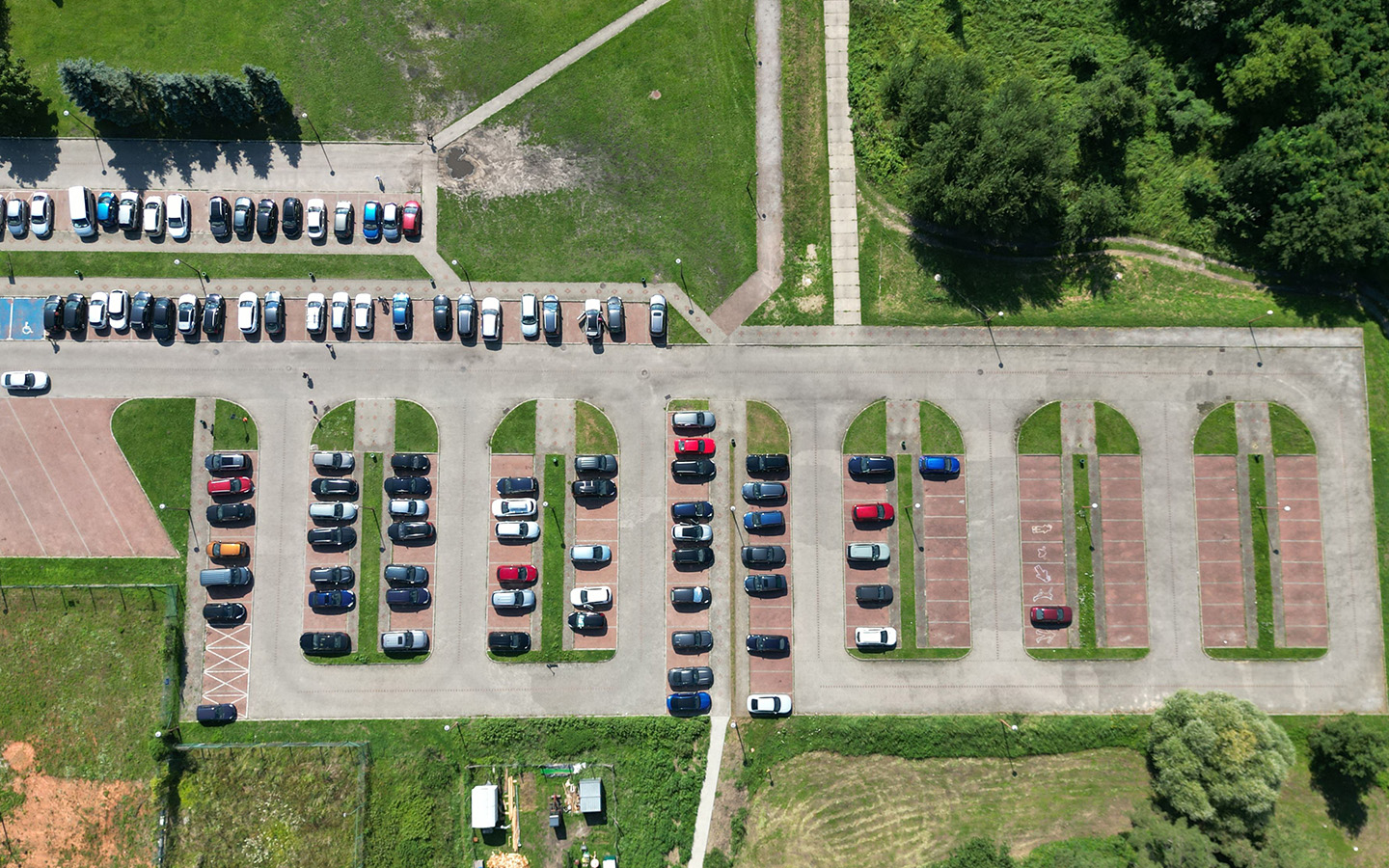
For a commercial real estate company, parking often accounts for the largest portion of the property’s land area. In a retail park or suburban shopping center, parking frequently accounts for 50 to 70% of the site’s total footprint—representing tens or even hundreds of hectares of impervious surface. Long considered merely a functional amenity, these spaces are now becoming a strategic issue under the combined pressure of regulations, ESG investors, and climate change.
An asphalt parking lot is not neutral in terms of the environmental impact of a commercial real estate portfolio. It has several problematic characteristics:
At a time when the European Taxonomy is requiring real estate stakeholders to measure their contribution to climate change mitigation and identify their physical risks (including heat waves), a portfolio of parking lots without vegetation is becoming a risk for downgrading.
It requires owners of outdoor parking lots larger than 1,500 m² to install solar canopies over at least 50% of their surface area by 2026 (lots larger than 10,000 m²) and 2028 (lots between 1,500 and 10,000 m²). This requirement presents an opportunity: redesigning the parking lot at the same time as installing the canopies optimizes earthwork and redevelopment costs.
The ZAN requires that net land-sealing be measured and reduced. The removal of impervious surfaces from existing parking lots is explicitly counted as a restoration measure, which allows real estate companies to improve their ZAN contribution score without reducing the number of parking spaces.
To be phased in starting in 2024, the CSRD requires large companies to provide detailed reporting on their environmental impact, particularly regarding biodiversity (ESRS E4) and climate change adaptation (ESRS E1). Parking lots, as real estate assets with a significant thermal impact and zero biodiversity, will need to be documented and incorporated into transition plans.
Transforming a shopping center parking lot does not mean eliminating parking spaces. The following solutions allow for greening while maintaining parking capacity:
Permeable paving — Replacing asphalt with permeable pavers or grass pavers allows the area to remain in use while making the ground permeable and lowering the surface temperature.
Planting trees to create a canopy — Tall trees planted every 3 to 4 spaces create a canopy that shades cars, reduces the heat felt by visitors, and contributes to long-term carbon sequestration.
Landscape swales and stormwater management — Installing vegetated swales in place of concrete gutters simultaneously addresses the issue of runoff and improves the site’s biodiversity score.
Combined shade structures and green roofs — Some shade structures incorporate climbing plants or green roofs, combining solar energy production, shade, and a contribution to biodiversity.
For a real estate company, the challenge isn’t just about adding greenery, but about demonstrating the impact to its investors, tenants, and lenders. Platforms like Netcarbon use high-resolution aerial imagery to:
Beyond compliance, greening parking lots contributes to the “green value” of commercial real estate. Commercial properties that incorporate environmental performance criteria have lower vacancy rates and more stable rental yields. A canopy over a parking lot also enhances the customer experience in the summer—a significant factor in building customer loyalty in the face of competition from e-commerce.
Shopping center parking lots are no longer a gray area in real estate companies’ ESG strategies. They have become a priority area for transformation, driven by the combined pressure of the 2023 Solar Law, the ZAN, the CSRD, and the expectations of institutional investors. Real estate companies that are anticipating this trend—by measuring, simulating, and documenting their greening projects—are positioning themselves ahead of the curve on an issue that will become unavoidable by 2026–2028.
Are you a real estate company looking to assess the environmental impact of your parking facilities for your CSRD reporting? Request a Netcarbon demo for your portfolio.

.png)