When it was created in 2019 by the Ministry of Ecological Transition, the Low Carbon Label (LBC) was primarily associated with agricultural and forestry projects: hedge replanting, changes in farming practices, and agroforestry. But the program has evolved significantly since then.
Today, several approved methods are directly applicable to urban renaturation and de-impermeabilization projects—paving the way for carbon offsetting for a type of project that had previously been overlooked in this context.
The LBC is a voluntary French funding mechanism for reducing or sequestering greenhouse gas emissions. A project developer implements actions that reduce GHG emissions or increase carbon sequestration; these actions are quantified using a method approved by the ministry, and the tons of CO₂ equivalent avoided or sequestered generate carbon credits that can be purchased by voluntary funders. The average price of an LBC carbon credit ranges from €25 to €45 per ton of CO₂ equivalent in 2024.
Launched in 2022, this certified method specifically covers urban renaturation projects: removing impervious surfaces, planting trees in urban areas, and greening impervious surfaces. It quantifies carbon sequestration by planted vegetation, emission reductions resulting from reduced air conditioning needs, and albedo effects.
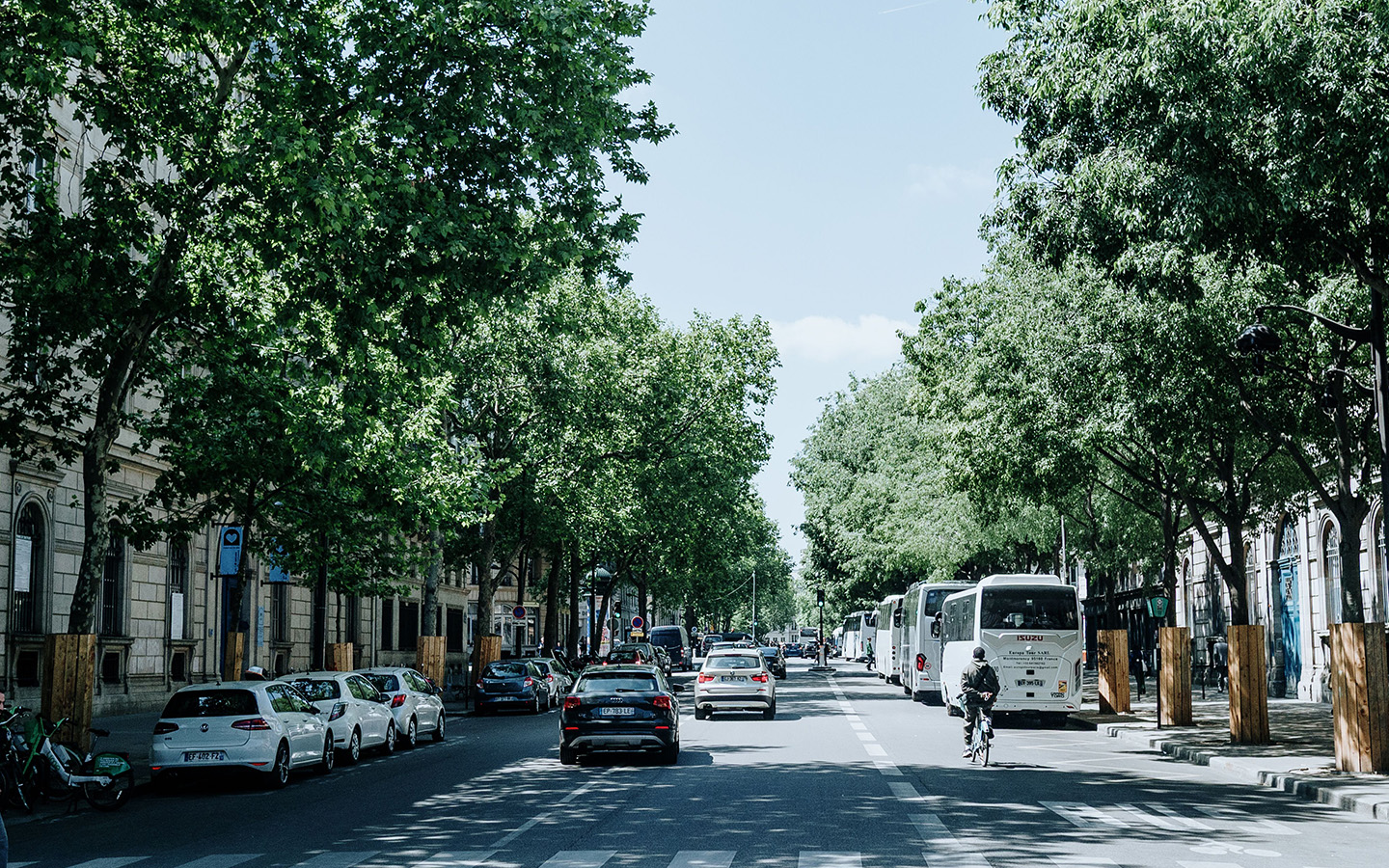
This method applies to tree-planting projects in urban and suburban areas. It is particularly well-suited to “canopy plan” projects led by local governments.
Obtaining the Low-Carbon Label for a restoration project opens the door to additional private funding. For a local government, this means that a restoration project can be co-financed by the private sector, thereby reducing the financial burden on public funds.
The LBC provides a standardized metric (t CO₂ eq) that can be included in environmental assessments, PCAET reports, and public communications.
An official ministerial designation lends credibility to the project and the community behind it. It is a strong selling point in calls for proposals, grant applications, and communications with the public.
The Low Carbon Label is based on rigorous quantification. Without precise data on the project’s baseline conditions and its progress, it is impossible to issue credits that meet the label’s requirements. This is why environmental assessment tools using remote sensing have become essential prerequisites for any Low Carbon Label initiative.
Netcarbon provides the environmental assessments you need to launch a Low Carbon Label initiative for your restoration projects. Find out how during a free demo.

.png)