Shopping Center Parking Lots: How Real Estate Companies Are Turning Their Asphalt Surfaces Into Green Assets
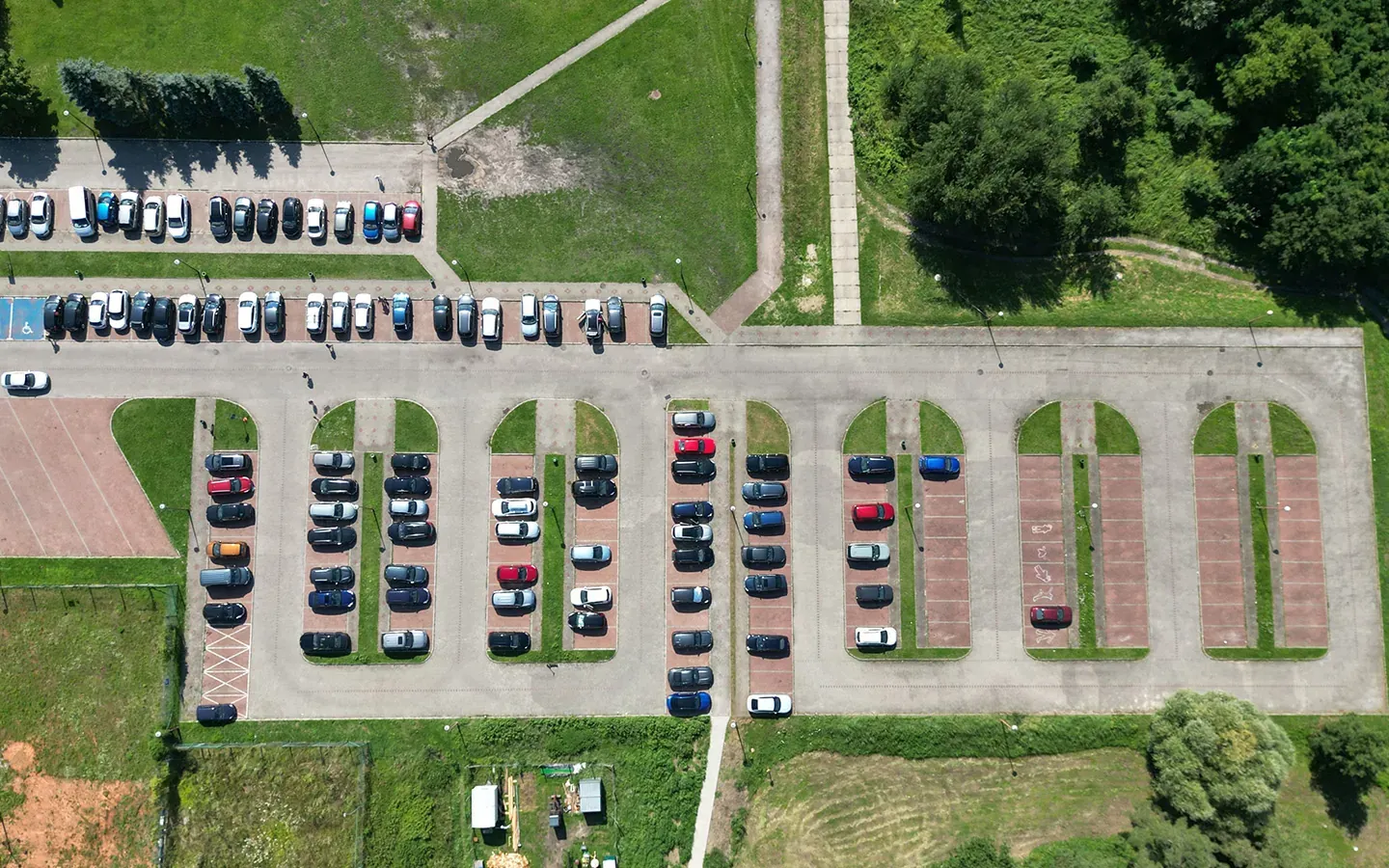
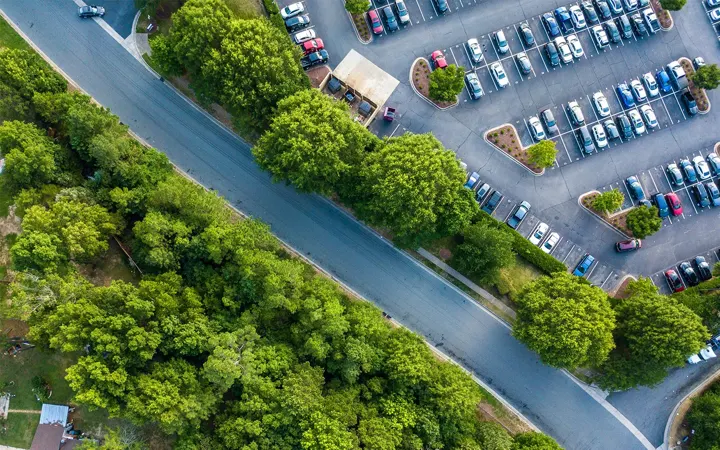
For a commercial real estate company, parking often accounts for the largest portion of the property’s land area. In a retail park or suburban shopping center, parking frequently accounts for 50 to 70% of the site’s total footprint—representing tens or even hundreds of hectares of impervious surface. Long considered merely a functional amenity, these spaces are now becoming a strategic issue under the combined pressure of regulations, ESG investors, and climate change.
An undervalued asset that concentrates risk
An asphalt parking lot is not neutral in terms of the environmental impact of a commercial real estate portfolio. It has several problematic characteristics:
- Complete soil sealing: increased runoff, zero infiltration, contributing to flooding in suburban areas
- Effet d'îlot de chaleur urbain intense : les températures de surface peuvent dépasser 60°C l'été, dégradant l'expérience client et augmentant les charges de climatisation des bâtiments adjacents
- No contribution to biodiversity: no habitat, no vegetation, biotope coefficient close to zero
- Indirect carbon emissions: The thermal effect of paved surfaces increases energy consumption in commercial buildings
At a time when the European Taxonomy is requiring real estate stakeholders to measure their contribution to climate change mitigation and identify their physical risks (including heat waves), a portfolio of parking lots without vegetation is becoming a risk for downgrading.
What the new regulations require
The Act of March 10, 2023 (Photovoltaic Shade Structures)
It requires owners of outdoor parking lots larger than 1,500 m² to install solar canopies over at least 50% of their surface area by 2026 (lots larger than 10,000 m²) and 2028 (lots between 1,500 and 10,000 m²). This requirement presents an opportunity: redesigning the parking lot at the same time as installing the canopies optimizes earthwork and redevelopment costs.
La loi ZAN (Zéro Artificialisation Nette)
Le ZAN impose de mesurer et réduire l'artificialisation nette. La désimperméabilisation des parkings existants est explicitement comptabilisée comme action de renaturation, ce qui permet aux foncières d'améliorer leur score de contribution au ZAN sans réduire le nombre de places.
The CSRD (Corporate Sustainability Reporting Directive)
To be phased in starting in 2024, the CSRD requires large companies to provide detailed reporting on their environmental impact, particularly regarding biodiversity (ESRS E4) and climate change adaptation (ESRS E1). Parking lots, as real estate assets with a significant thermal impact and zero biodiversity, will need to be documented and incorporated into transition plans.
Available greening initiatives
Transforming a shopping center parking lot does not mean eliminating parking spaces. The following solutions allow for greening while maintaining parking capacity:
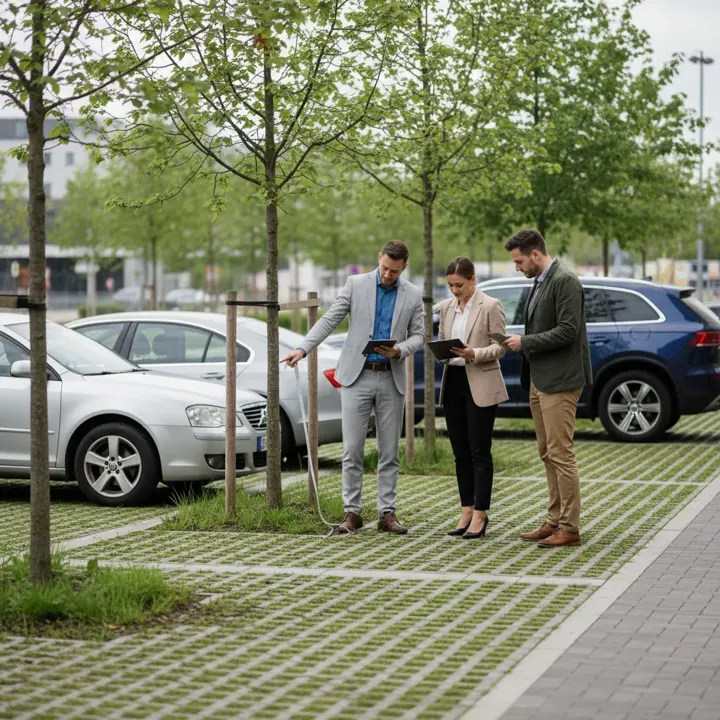
Revêtements alvéolaires perméables — La substitution du bitume par des pavés alvéolaires ou des dalles engazonnées permet de conserver l'usage tout en rendant le sol perméable et en abaissant la température de surface.
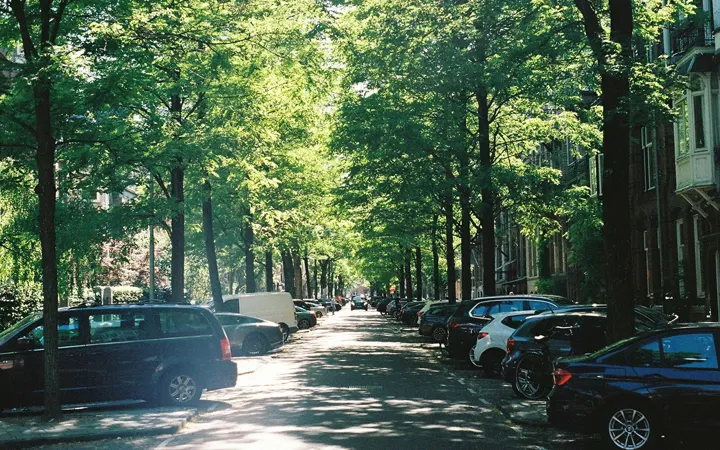
Planting trees to create a canopy — Tall trees planted every 3 to 4 spaces create a canopy that shades cars, reduces the heat felt by visitors, and contributes to long-term carbon sequestration.
Landscape swales and stormwater management — Installing vegetated swales in place of concrete gutters simultaneously addresses the issue of runoff and improves the site’s biodiversity score.
Combined shade structures and green roofs — Some shade structures incorporate climbing plants or green roofs, combining solar energy production, shade, and a contribution to biodiversity.
Measuring to Convince: The Issue of Environmental ROI
Pour une foncière, l'enjeu n'est pas seulement de végétaliser, mais de prouver l'impact à ses investisseurs, à ses locataires et à ses financeurs. Des plateformes comme Netcarbon permettent, à partir d'images aériennes haute résolution, de :
- Diagnostiquer l'état initial de chaque parking du patrimoine : surface imperméabilisée, température de surface, taux de végétalisation, stock de carbone
- Simulate multiple greening scenarios and compare their impacts over a 25-year period
- Produce verifiable indicators: temperature variation (°C), tons of CO2 sequestered, area of unsealed land, change in the biotope coefficient
- Supply CSRD and Taxonomy reporting with geolocated and traceable data
A tool for asset appreciation
Beyond compliance, greening parking lots contributes to the “green value” of commercial real estate. Commercial properties that incorporate environmental performance criteria have lower vacancy rates and more stable rental yields. A canopy over a parking lot also enhances the customer experience in the summer—a significant factor in building customer loyalty in the face of competition from e-commerce.
Conclusion
Shopping center parking lots are no longer a gray area in real estate companies’ ESG strategies. They have become a priority area for transformation, driven by the combined pressure of the 2023 Solar Law, the ZAN, the CSRD, and the expectations of institutional investors. Real estate companies that are anticipating this trend—by measuring, simulating, and documenting their greening projects—are positioning themselves ahead of the curve on an issue that will become unavoidable by 2026–2028.