How the popcorn industry compensates its farmers based on carbon sequestration
Comfortably ensconced in his armchair, the consumer has no idea that the popcorn he eats while watching his movie can help reduce the effects of climate change by storing carbon in the soil.
Aujourd’hui, l’agriculture est responsable d’environ 20 % de nos émissions de CO2 en France. Cependant, elle est également au cœur des solutions pour lutter contre le changement climatique. En effet, un des plus grands potentiels de séquestration du carbone se trouve dans nos sols. Actuellement, le stock de carbone contenu dans les sols est d'environ 1 700 GtC, soit deux fois plus de carbone que dans notre atmosphère, et ce stockage pourrait être considérablement augmenté grâce à la mise en œuvre de pratiques agro-écologiques. Partant de ce constat, Netcarbon a développé une solution permettant de suivre, partout sur terre, le déploiement d'initiatives de séquestration du carbone en agriculture. Une de ces initiatives est notamment la mise en place de couverts intermédiaires.
An intermediate cover crop is a crop planted between two harvested crops. Its purpose is to remain on the plot and be buried in the soil to nourish and protect it before the next crop is sown. Intermediate cover crops represent a huge opportunity for agriculture and for our planet. Not only do they improve soil structure, limit erosion and increase organic matter, while helping to optimize the PEA (Plan Épargne Azote 😄), but they also act as natural carbon sinks. Until recently, quantifying the amount of carbon captured by this practice required field measurements, a time-consuming, expensive process that did not always provide an objective measure of the average condition of the plot.
Aujourd'hui, il est possible de quantifier la biomasse des couverts grâce à des données satellitaires. Le partenariat entre Nataïs, leader Européen du maïs pop-corn, le CESBIO, laboratoire de référence sur l’étude du fonctionnement de la biosphère et la télédétection, et Netcarbon, expert en mesure de la captation de carbone, marque le début d’une nouvelle ère. Ce partenariat permet de mesurer précisément la biomasse des couverts intermédiaires tout au long de leur cycle ainsi que le carbone qu'ils stockent dans nos sols, offrant ainsi une solution efficace pour suivre et amplifier le déploiement de cette pratique sur l’ensemble du territoire.
A silent revolution driven by Nataïs
In the heart of the Gers, Nataïs is not only the European leader in popcorn. It's a company deeply committed to the agro-ecological transition. For years, Nataïs has been working hand in hand with over 200 farmers to build a more environmentally-friendly agriculture.
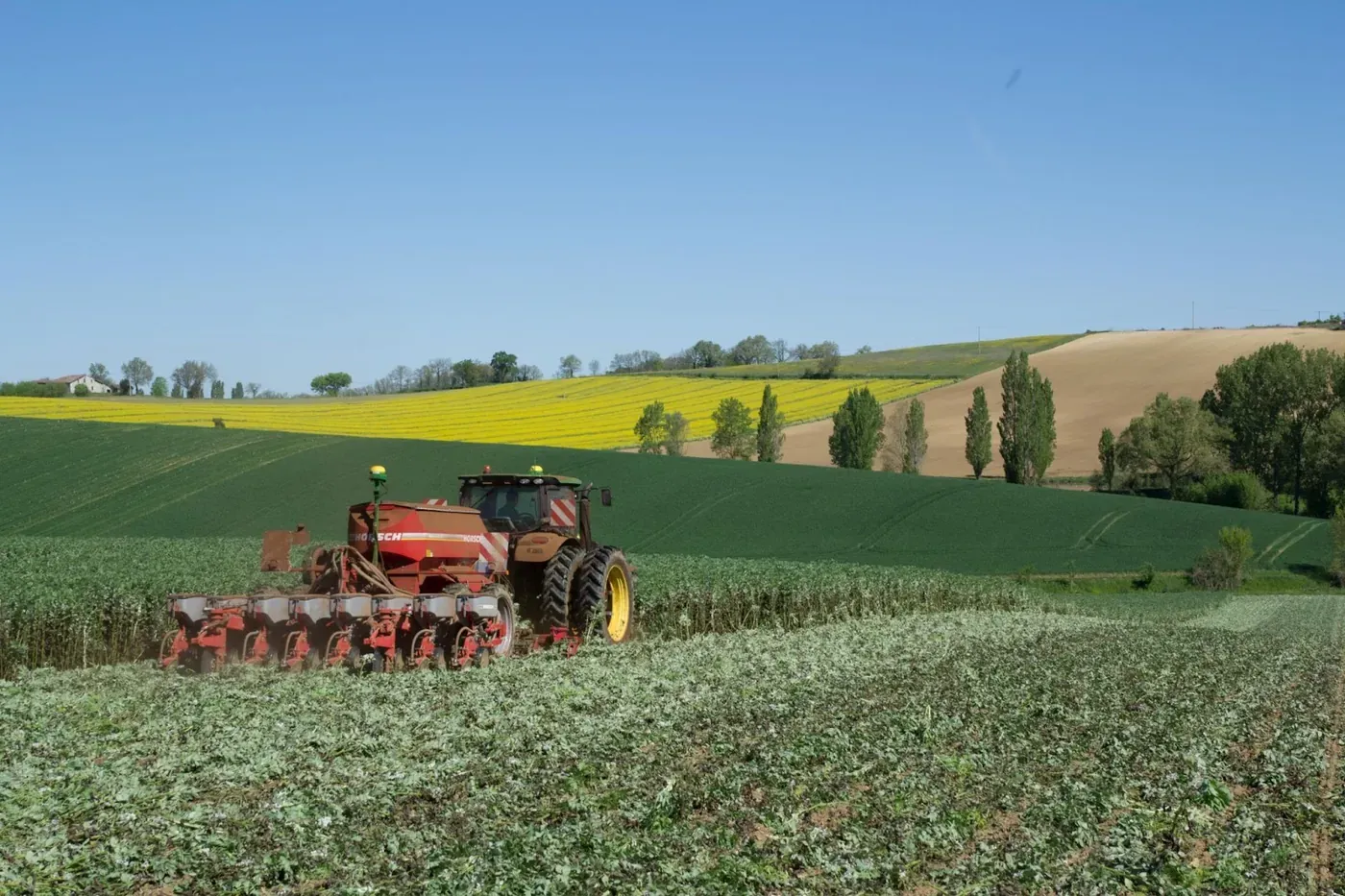
Nataïs' great strength lies in its visionary approach: integrating and financing intermediate cover crops into farmers' crop rotations to improve soil health while capturing atmospheric carbon. These cover crops play an essential role, but to go even further, we needed a precise and reliable way of measuring their impact.
The challenge: Quantifying biomass and stored carbon
How can we effectively monitor the impact of these intermediate cover crops? How can farmers be fairly remunerated for the carbon they store in the soil? How can we promote these practices to the companies that buy popcorn? The answer came in the wake of the Naturellement Popcorn project. Building an industrial approach, supported by satellite data and modeling, to quantify the biomass of intermediate cover crops and the evolution of soil carbon stocks.
What used to be available only on a very small number of plots can now be quantified on a large scale and at a resolution of 10 meters, paving the way for the deployment of an objective and fairer carbon premium for farmers.
La technologie : La collaboration CESBIO & Netcarbon
En collaboration avec le Centre d’Études Spatiales de la Biosphère (CESBIO), Netcarbon a industrialisé l’outil de modélisation AgriCarbon-EO en l’intégrant à sa solution d’analyse du carbone. Fruit de plus de 10 ans de recherche, AgriCarbon-EO est une méthode hybride qui s’appuie sur trois technologies :
L’observation satellite de la végétation
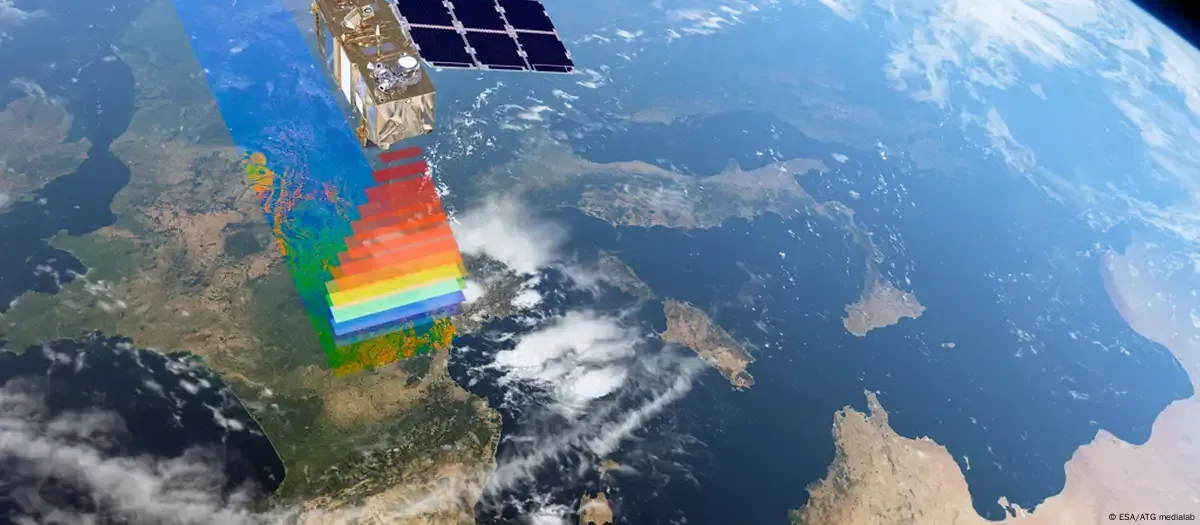
L’observation satellite nous offre une vision inédite de notre planète, capturant des images tous les 5 jours à une résolution de près de 10 mètres. Grâce à leur précision et à leur fréquence de revisite, les satellites Sentinel-2 de l’Agence Spatiale Européenne et Landsat de la NASA nous permettent de surveiller de près la végétation. En mesurant la lumière réfléchie par la végétation grâce aux satellites, le modèle PROSAIL permet de calculer le LAI. Mais qu'est-ce que le LAI, exactement ? Le LAI (Leaf Area Index) représente la surface des feuilles par unité de surface au sol, exprimée en m² de feuilles par m² de sol. Cet indice permet de quantifier précisément la densité de la couverture végétale d'une parcelle.
La modélisation du cycle de la végétation
AgriCarbon-EO inclut le modèle agronomique SAFYE-CO2 développé au CESBIO, qui utilise des informations agrométéorologiques et des paramètres de culture pour simuler les productions agricoles (biomasse, rendement) ainsi que les flux de CO2 entre les parcelles et l'atmosphère. SAFYE-CO2 modélise aussi le LAI que le satellite est capable d’observer, ce qui nous emmène à la troisième technologie.
Integrating satellite data into the agronomic model
The final component is the integration of satellite LAI into the agronomic model. In fact, LAI is both measured by the satellite and simulated by the model! This is where the magic happens: based on Bayesian statistical methods, which take into account the uncertainties of satellite observation and model predictions, optimal vegetation cycle trajectories are identified. This enables us to calibrate the model on the basis of all this data, which is now accessible from anywhere on earth, via our application and our APIs. Our APIs (Application Programming Interfaces) make it easy to integrate our data into our customers' tools with just a few lines of code, further simplifying access to this information.
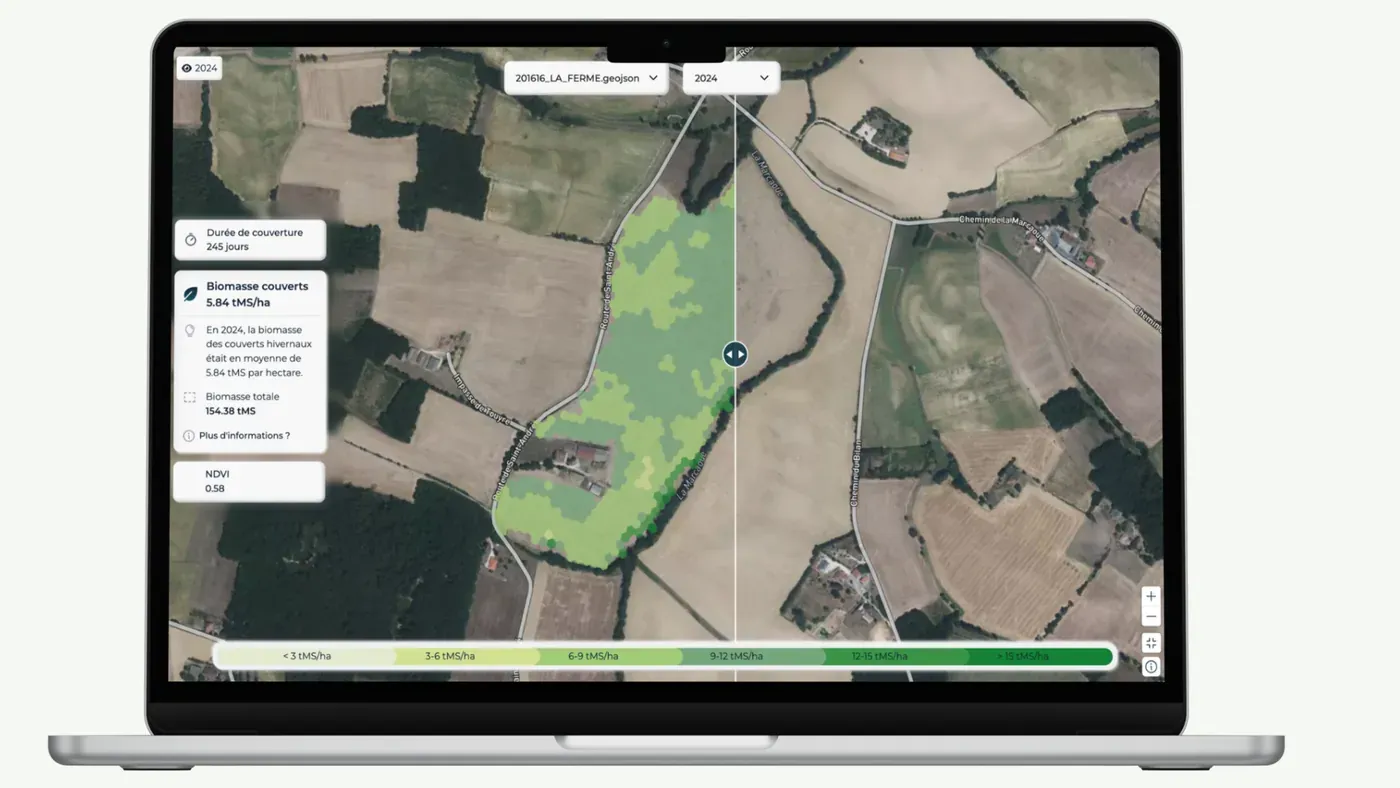
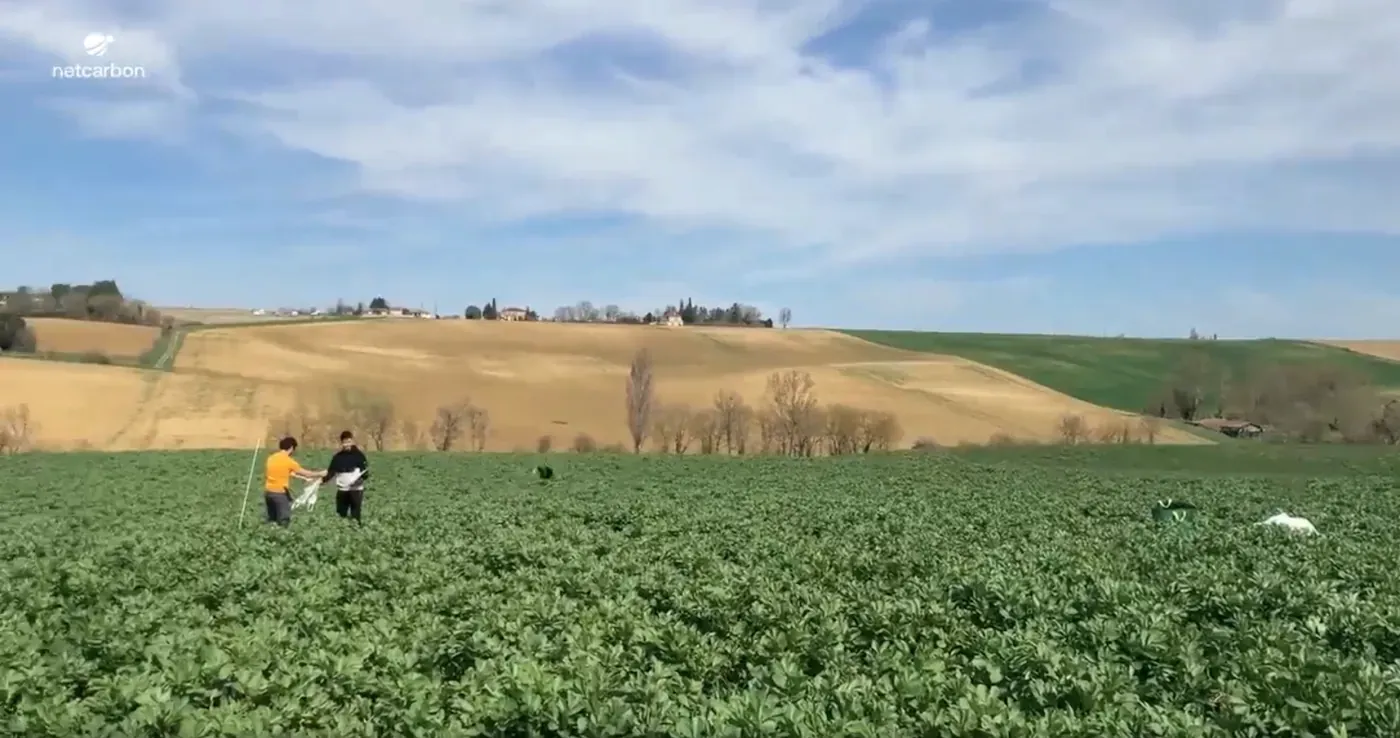
Netcarbon améliore tous les jours l’approche. L’équipe s’est rendue dans le Gers sur les parcelles du réseau Nataïs en mars 2024. Cette rencontre avec les agriculteurs a permis de mieux comprendre leurs pratiques, mais aussi de réaliser plus d’une centaine de prélèvements de biomasse de couvert intermédiaire. Nous avons comparé notre monitoring par satellite avec la réalité du terrain. Le résultat ? Une erreur inférieure à 1 tonne de matière sèche par hectare !
Concrete benefits for farmers
The impact of biomass measurement goes far beyond data. For farmers, it's an opportunity to transform their practices while benefiting from a financial return.
- A carbon premium: By quantifying the carbon stored, Nataïs values the sequestered tonne of CO₂ at €45. In 2024, the average carbon premium amounts to €78 per hectare, offsetting the majority of the costs associated with planting cover crops. In addition, a floor premium of €45 per hectare has been introduced to secure and encourage farmers' commitment to this approach.
- Improved soil health: Intermediate cover crops improve soil structure, making it more fertile and more resistant to erosion. By trapping nitrogen and enriching the soil with organic matter, these practices boost long-term agricultural productivity.
- More resilient agriculture: With healthier soils, farmers are better prepared to face tomorrow's climatic challenges.
+ 8,000 tonnes of CO₂ absorbed
This year, over 8,000 tonnes of carbon were stored in the soil thanks to the intermediate cover planted by Nataïs partner farmers. This figure illustrates the impact of this practice in the fight against climate change.
To better grasp the scale of this figure, 8,000 tonnes of CO₂ represents the amount of CO₂ absorbed by nearly 320,000 mature trees in a single year, or the equivalent emissions of 4,000 return flights between Paris and New York. These examples show that the combined efforts of Nataïs and its farmers are already having a significant impact - and this is just the beginning!
The potential is even much greater: by generalizing intermediate cover on all farmland in France, we could absorb up to 12 million tonnes of CO₂ per year. This would be equivalent to offsetting the emissions of 1.4 million people every year, or absorbing 14% of the French agricultural sector's total emissions. These figures highlight the immense power of this practice for the climate, while also helping to strengthen the resilience of our agriculture.